SECTION 01
Having No Ideas Isn't a Creativity Problem
You want to start building something, but nothing comes to mind. This is incredibly common, yet the root cause isn't a lack of imagination. The real reason you're stuck is that you haven't clarified why you want to build in the first place.
When your purpose is vague, you end up searching for "something cool" with infinite options and zero criteria for choosing. But the moment you decide whether you're building to learn, to land a job, or to earn revenue, the conditions for your ideal project change dramatically.
Another common trap is the belief that you need to build something groundbreaking. Similar services already existing is not a problem. A clone of an existing product still has learning value, and adding a niche angle makes it a different product entirely.
So the first step isn't brainstorming — it's writing down your purpose in a single sentence. "What am I building this for?" Once you can answer that clearly, your options naturally narrow down.
I've personally built over 40 projects, and the vast majority were failures. What kept me going was abandoning the search for a perfect idea and focusing on choosing projects that matched my purpose. Accepting that you don't need to pick a winner on your first try is essential for taking that first step.
SECTION 02
Different Goals Demand Completely Different Projects
Indie dev goals generally fall into three categories: learning, career/portfolio, and monetization. Each demands entirely different qualities from your project, which is why searching without a clear goal leads nowhere.
If learning is your goal, trying new technology is the priority. A small-scale clone of an existing service works perfectly. There's no need for originality — the value lies in completing something functional with an unfamiliar tech stack.
If career building is your goal, the key question is whether you can talk about it in an interview. What matters isn't novelty but having experience-based reasons for why you chose this problem and this technology.
Here's how the criteria differ by purpose:
- Learning: Technology is the star. Keep the concept simple and prioritize finishing
- Career: Your problem choice and tech decisions need a "story" rooted in your experience
- Monetization: Pick problems with high frequency and continuity, then go niche
- Multiple goals: Prioritize one. Don't try to serve all purposes at once
For monetization, choose problems based on how frequently they occur. A minor inconvenience that happens every week beats a major pain point that occurs once a year. Targeting a specific profession or community rather than a broad market gives you a realistic edge as a solo developer.
If you have multiple goals, commit to just one for your first project. Trying to learn a new framework while also monetizing creates conflicting decisions. Focus on one purpose now, and tackle another with your next project.
SECTION 03
A Practical Framework for Catching Ideas in Daily Life
Once your purpose is set, start collecting seeds for your project. The most reliable method is building a "frustration log" habit. Whenever you hit a small inconvenience in your day, jot down a one-liner in a notes app on your phone.
I've maintained a habit of dumping fragmented thoughts into a simple note-taking app for years. The key is externalizing observations and frustrations rather than trying to conjure a complete idea. When people say they have no ideas, they're usually trying to assemble a finished concept entirely in their head.
When evaluating your frustration log, prioritize frequency and continuity over intensity. A massive problem you face once a year is less useful than a minor annoyance that hits you every week. Frequency is what makes a problem viable for indie dev.
Here's the process from frustration log to project choice:
- Step 1: Collect a few frustration notes per week
- Step 2: Identify which ones recur repeatedly
- Step 3: Consider whether others share the same frustration
- Step 4: Shape it into something solvable with minimal features
Another powerful approach is starting with a tool built just for yourself. Don't think about other users initially — build something you'll use every day. This gives you a genuine sense of whether it's actually useful before you ever show it to anyone.
When you only publish things you've personally validated, you can write about them with authentic conviction. Being both the user and the developer lets you iterate on feedback instantly, which is a unique advantage of the self-tool approach.
SECTION 04
Cutting Your Idea Down to a Buildable Size
Once you have a direction, the next step is trimming it to a size you can actually finish. At the idea stage, it's tempting to pile on features, but doing so in indie dev is a guaranteed path to an unfinished project.
The first things to cut are high-maintenance features. Authentication, payments, notifications, and admin panels should all be excluded from your first version. They're time-consuming to build and usually aren't part of the core experience you need to validate.
Here's a guide for what to defer from your first version:
- Auth: Use the simplest possible method — passwordless or invite-only
- Payments: Launch free first. Add billing only after you see traction
- Notifications: Skip push and email. Manual processes work fine initially
- Admin panel: Query the database directly in the early days
Your MVP should work with a single feature. Ask yourself: "What's the one thing this app absolutely must do?" Build only that. Give users the core experience in its most minimal form.
A good rule of thumb for scope is whether you can ship it within one to two weeks using your available free time. Beyond that, motivation tends to fade. An unfinished product has zero value, so scoping down isn't compromise — it's strategy.
In my experience, I've had many projects die from overscoping. Conversely, things I shipped small often got unexpectedly positive responses. If you feel nervous that it's "too little," you're probably at the right size.
SECTION 05
Project Ideas by Purpose
With the framework above in mind, here are directional examples for each purpose. These are starting points — adapt them to your own experience and interests.
For learning, small-scale clones of existing services are the most efficient choice. Think task managers, chat apps, or bookmark organizers — projects where the spec is obvious so you can focus entirely on mastering the technology.
Key considerations for learning projects:
- Mix in only one new technology: Going all-new on every layer leads to burnout
- Prioritize completion: A working app teaches more than perfect code
- Publish it: Shipping creates motivation for the next project
For career and portfolio projects, build tools that solve problems from your own work experience. A tool addressing inefficiencies you've personally faced lets you tell a compelling story in interviews about why you built it and what you learned.
For monetization, target small inconveniences in niche domains. A general-purpose tool for everyone will lose to established players. By narrowing your focus to a specific profession, hobby, or workflow, you can reach a small but highly engaged audience much more effectively.
Having built over 40 projects, what I've learned is that your first idea almost never hits. What matters is building, shipping, observing reactions, and pivoting quickly when needed. Spending too long choosing the perfect idea is less effective than shipping something small and course-correcting.
SECTION 06
Why It's Fine to Build Something That Already Exists
"Something similar already exists, so there's no point building it." Many people freeze at this thought, but this is the single most unnecessary worry in indie dev. The existence of similar services actually proves that demand exists in that space.
Major platforms serving broad audiences often have too many features for specific user groups, or miss niche needs entirely. The strength of indie dev is filling those exact gaps. A simple, focused tool for a specific use case always has an audience.
Differentiation comes not from feature count but from a different angle. The same "task management" concept becomes a different product when you limit it to freelancers, optimize it for a specific workflow, or radically simplify the interface.
Key principles for building in a space with existing solutions:
- Narrow your target: Serve a specific group, not everyone
- Reduce features: Go the opposite direction from feature-rich incumbents
- Change the experience: Solve the same problem in a different way or with better UX
For learning purposes, cloning an existing service is the best possible exercise. You skip the spec design phase entirely and focus on building skills. Let go of the idea that only original projects count.
SECTION 07
Choose by Frequency, Not Intensity
When evaluating project ideas, most people focus on how painful a problem is. But in indie dev, frequency and continuity matter far more than intensity. A small hassle that occurs weekly is a better project than a huge pain point that happens once a year.
High-frequency problems mean users have a reason to keep opening your app. Repeat usage leads to word-of-mouth growth and makes it much easier to introduce a paid tier down the road.
Here's how to prioritize when evaluating problems:
- Frequency: How often does this inconvenience occur?
- Continuity: Is this a temporary issue or an ongoing one?
- Audience size: Do other people share this frustration?
- Solution simplicity: Can it be solved with a straightforward mechanism?
From my experience, "boring but frequent" problems tend to produce tools with the longest lifespans. Instead of chasing flashy ideas, look at the small stresses you encounter repeatedly in your daily routine.
Go back through your frustration log with this lens, and the entries marked "this is annoying every time" will stand out. Those are your strongest candidates for a first project.
SECTION 08
It's Okay If Your First Choice Is Wrong
Choosing carefully matters, but fearing a wrong first choice is counterproductive. Having built over 40 projects, I can say with confidence that the first idea almost never succeeds as-is.
What matters is getting to a point where you can make informed decisions quickly. Rather than perfecting an idea in your head before starting, build something small, ship it, observe, and adjust. This approach is more reliable every time.
I've personally had to pivot a service when the original direction wasn't working. Treating a pivot as "validated learning" rather than "failure" is the mindset that sustains long-term indie development.
To make pivots smoother, keep these principles in mind:
- Build the first version small: The bigger you build, the harder it is to change direction
- Get user feedback early: Don't aim for perfection before shipping
- Decide with data, not emotion: If response is weak, switch quickly
Every failed project becomes input for your next decision. Over 30 failures taught me lessons that directly shaped later successes. You don't need to bet everything on your first idea.
SECTION 09
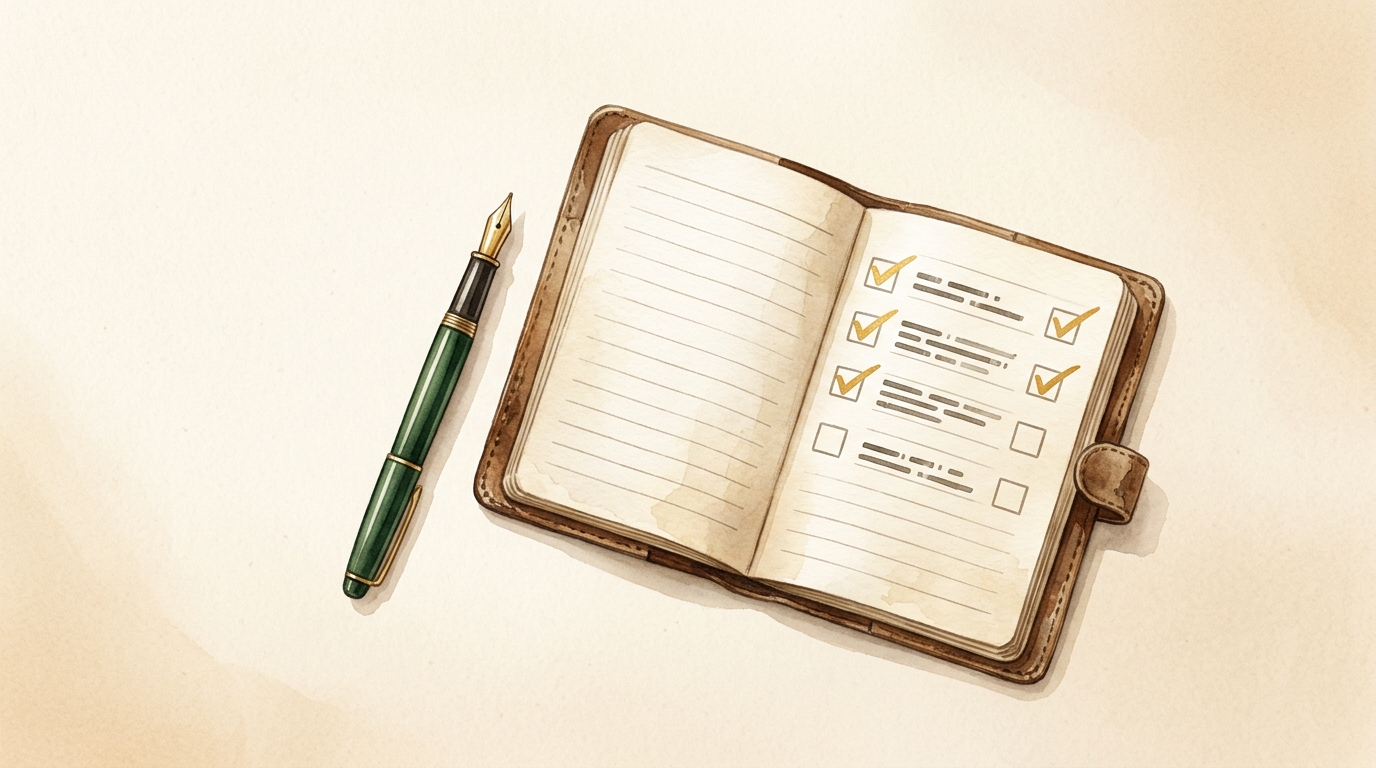
A Checklist for Getting Started Right Now
Once you've picked a direction, write down just three things before you start coding: your purpose, your target user, and your core feature. These three lines will keep you from drifting during development.
For example:
- Purpose: Build a portfolio piece that demonstrates problem-solving ability
- Target: Freelance designers struggling with invoice management
- Core feature: Generate per-project invoices in one click
For tech choices, stick with what you already know as your base. If there's a new technology you want to learn, add just one. Going all-new across frontend, backend, and infrastructure is a recipe for exhaustion before you even touch your core feature.
Another crucial point: don't wait for completion to go public. The feedback you get from publishing beats anything you'll figure out on your own. Ship the moment you have the smallest usable version.
Continuously writing, building, and shipping is the single greatest advantage in indie dev. Don't wait for the perfect idea to materialize. Decide on a project with what you know today, and write your first line of code today. That speed of iteration is ultimately the shortest path to a great product.
If you're feeling stuck with no ideas right now, this is actually the perfect moment to clarify your purpose and take the first step. Use the framework from this article and start by writing just one frustration note today.