SECTION 01
Promotion Starts Before Launch, Not After
I used to think promotion was something you do after the product is finished. After building over 40 products, most of them ended the same way: nobody found them.
In the early days, posting on social media after launch got virtually zero response. A few friends would sign up, and that was it. Looking back, the problem was clear — I was only focused on building, not on being discovered.
What I learned through repeated failure is that the entry point for promotion needs to be designed into the product itself. Scrambling to announce after launch is structurally too late.
For example, I deliberately design my products to be usable without login. This isn't just a UX choice — it's a promotion strategy. The easier it is to try and share, the wider the entry point becomes.
One service I built had to pivot because I had no plan for how it would reach people before I started building. The product was technically complete, but the distribution path wasn't designed. That's where the failure began.
Promotion isn't a launch-day event — it's a part of product design. Building a frictionless experience, embedding share triggers, making the product instantly accessible. That's the foundation for your first 100 users.
SECTION 02
The Zero-Budget Promotion Map
The channels available to indie developers are limited, but the free options are more powerful than most realize. The key is prioritization — don't try to do everything at once.
Here's the priority order I follow:
- Social media presence: Consistent posting builds the momentum that drives launch-day traction
- ASO (App Store Optimization): Zero-cost, always-on organic traffic
- Tech community posts: Deep resonance with niche audiences
- Direct outreach (DMs): Effective when your target is clearly defined
- SEO content: Long-term inbound investment
The critical principle here is don't bet on a single channel. Promotion follows the same rhythm as development — if something isn't working, pivot quickly. Run multiple channels in parallel and watch what sticks.
Your first 100 users are a quality problem, not a quantity problem. A hundred engaged fans who genuinely use your product will create the spark that spreads through word of mouth and shares. Engagement rate matters more than follower count.
In my experience, products where the first few dozen users were genuinely enthusiastic grew steadily over time. Products that got a spike of traffic but no retention went nowhere.
SECTION 03
The Highest-ROI Strategy: Growing Your Own Media Presence
The single most effective promotion channel I've found is building your own social media presence over time. Rather than pitching a product directly, sharing what you're building and why you're building it reaches further in the long run.
This started during my freelance years. I committed to writing blog posts consistently, and eventually work started coming through the blog. Clients would see the products I'd built and reach out for development projects. I wasn't trying to sell — I was just showing up consistently.
App promotion follows the same structure. When I launched MENTA — a platform connecting mentors and mentees — I was able to bring 200 mentors on day one because of the social media presence I'd built over the preceding years. That traction didn't come from nowhere.
With consistent account growth, the launch velocity of each new product changes dramatically. Recent launches now get hundreds of likes on the announcement post and bring in dozens to hundreds of users on day one.
A key principle here: build something you'd use yourself. When your personal interests align with your content, your followers naturally match your product's target audience. MENTA's programming category dominated because my audience was already engineers and indie developers.
SECTION 04
Beyond Social Media: ASO, Communities, and Short-Form Video
ASO is the most overlooked high-priority tactic — it costs nothing and generates continuous organic traffic once optimized. Beyond keyword selection, visual elements like screenshots and preview videos are increasingly important for conversion.
Key ASO principles I follow:
- Include primary keywords naturally in the app name
- Design screenshots that show real usage scenarios
- Front-load the value proposition in the description
- Periodically review and adjust keywords based on performance
Product launch platforms that used to be the go-to for indie developers have become less effective. Increased competition from well-funded teams and spam-like usage have made it harder for individuals to stand out.
What works better now is posting in tech communities and niche forums. The shift from "reach broadly" to "resonate deeply" is real. Sharing the story behind your product alongside the product itself creates genuine engagement.
Short-form video platforms are uniquely powerful for unknown developers because their algorithms prioritize content engagement over follower count. You can get distribution with zero existing audience.
Across all major platforms, algorithms increasingly favor original content over reposts and aggregation. Content rooted in your own experience performs better than generic advice. This shift works in favor of indie developers who have real stories to tell.
SECTION 05
Why Paid Ads Don't Work at Indie Scale
You might wonder why not just run ads. I've tried search ads, social media ads, affiliate programs, and mobile app ads across multiple products. The conclusion: the economics don't work at indie scale.
Modern ad platforms rely on machine learning that needs substantial conversion data to optimize. With a small monthly budget, there's simply not enough data for the algorithm to learn, and your money disappears with nothing to show for it.
For ads to be viable, you need all of the following:
- A monthly budget in the thousands of dollars
- A product with high enough LTV to justify the spend
- Enough runway to accumulate the conversion data the algorithm needs
Most indie products don't have high enough LTV to support this, making the cost-per-acquisition structurally unsustainable. On top of that, you're competing against professional marketers who do this full-time.
The compounding value of consistent content creation far exceeds what ads deliver at this scale. I was able to sell one of my services through M&A because it had real users and real revenue — built through organic growth, not ad spend. That kind of trust doesn't come from paid traffic.
SECTION 06
Content That Works: Information Over Opinion, Consistency Over Volume
Many developers use social media but see no connection to their product's growth. The root cause is almost always inconsistency and self-centered content — posting whatever feels interesting rather than what the audience needs.
When you're unknown, opinions don't land. Start by delivering pure information. My first post that gained real traction was a curated collection of official documentation links — useful, no ego, just value.
Content that performs well follows predictable patterns:
- Break down recent developments in a clear, accessible way
- Explain complex topics simply
- Add a personal layer — your experience, your take, your additional context
Equally important is thematic consistency. If your feed jumps between indie dev, life hacks, and hobbies, your follower base fragments and engagement drops across everything.
Pick your lane and stay in it. Lead with what your audience wants to know, then weave in what you want to say. Reversing this order turns your feed into a monologue.
Authenticity matters, but avoid negativity. Dishonesty gets spotted instantly, but attracting followers through controversy won't give you users who care about your product.
SECTION 07
Each Platform Has Its Own Rules
The same content performs completely differently across platforms. The user base, culture, and algorithm of each one create distinct environments that demand distinct approaches.
On my video channel, the audience skews older and overwhelmingly male. On short-form video platforms, the audience is younger with a significant female demographic. Knowing this changes how you frame the exact same information.
Here's a rough framework for platform strengths:
- Text-first platforms: Breaking news and timely takes perform best
- Long-form platforms: Personal stories and deep dives get read and shared
- Short-form video: Algorithm-driven, so follower count matters less
Algorithm changes are constant and consequential. Posts that used to reach your followers reliably may now get buried. The only way to stay current is to observe your feed daily and track how engagement patterns shift.
My approach is relentless observation. Study what's working for others, analyze the format and framing, adapt it to your content, and iterate. It's not glamorous, but it's the most reliable path to growth.
SECTION 08
Solo App Developers Who Tell Stories Win
Nobody wants to see a product announcement. Feature lists and release notes don't spread unless the product is genuinely groundbreaking — and most aren't.
What indie developers can offer that companies can't is the story of who built it and why. When I publicly committed to quitting client work and going all-in on indie development, sharing that journey in real time gradually built an audience that cared about what I'd build next.
Accounts that attract followers share common traits:
- You can follow the journey as it unfolds in real time
- You see what works and what fails
- The person behind the product feels genuine and worth supporting
In many ways, indie developers are closer to artists than to startups. You share your creative vision, build an audience that resonates with it, and offer your work to people who already believe in what you're doing.
Consistent presence means your audience already has context when you launch something new. That's a fundamentally different — and far stronger — position than cold-announcing to strangers. And it costs nothing.
SECTION 09
5 Steps You Can Take This Week
Here's how to translate everything above into action this week. The goal is to have your foundation in place within seven days.
Step 1: Define your target in one sentence. "People in [situation] who are struggling with [problem]." Trying to reach everyone means reaching no one.
Step 2: Pick one content theme and commit to consistency. Choose the intersection of what you know deeply and what your target audience wants to learn. If this drifts, your follower base fragments.
Step 3: Post one useful piece of information every day. Information first, opinions later. Formats that work well:
- Summarize something new in your field
- Share the results of something you tried
- Offer a specific insight from your own experience
Step 4: Watch the data and identify what resonates. Track engagement on each post and look for patterns. When something doesn't work, switch approaches quickly — the same principle that applies to product development applies here.
Step 5: Expand your best-performing posts into long-form content. Take what resonated in short form and develop it into blog posts, articles, or videos. Validating in short form first, then expanding, is the most efficient workflow.
SECTION 10
Slow Accumulation Beats Viral Moments
In indie development, aiming for steady accumulation of trust and traffic beats chasing viral moments. A single spike in attention has no lasting value without a system to retain those users.
One of my services grew its revenue month by month until it reached a point where I was able to sell it through M&A. The buyer wasn't interested because of a viral post — they cared that the product had a track record of real users and real revenue, built through sustained organic effort.
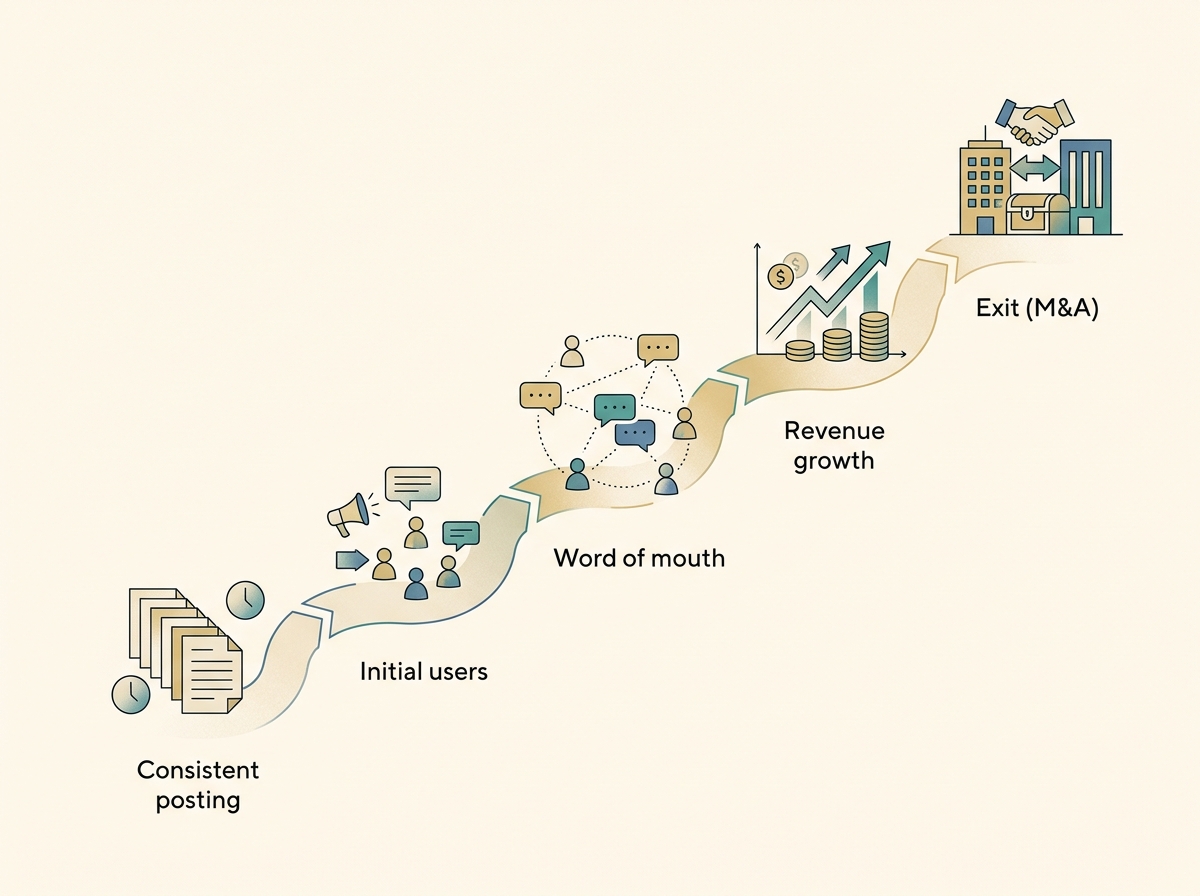
100 deeply engaged users are enough to ignite real growth. The question isn't how many followers you have — it's whether the people using your product genuinely care about it. The funnel design covered in this article is how you find those 100 people.
The era of "build it and they will come" is over. Building and distributing are equally important, and both need to be considered from the design phase. But you don't need an ad budget. You need the commitment to keep showing up and the discipline to keep improving based on what you observe.